Skip to content
Named Best Museum 2022
by Miami New Times

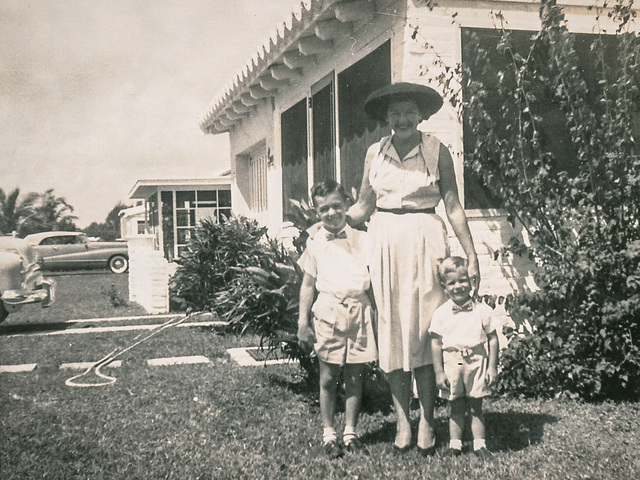
The Village of Biscayne Park was, during the ’50s and ’60s, a residential community of small neighborhoods squeezed between Miami Shores and North Miami. A single block would house a group of families who were as familiar with one another as they were with close relatives.

In the period following World War II, there were a great many such neighborhoods with adults and children of similar ages. The Baby Boomers were booming.

Children played together in the street and adults had regular barbecues and canasta parties. Everyone knew everyone else on the block. Children spent Saturdays at the Shores Theater. A matinee would have two westerns and possibly 20 cartoons. An afternoon’s entertainment could be had for less than 50 cents. Since we were living in a two-bedroom house, I credit those long matinees for giving my parents enough time to give me a brother to harass.

Polio was very much a part of our lives back then. Two kids on our block were stricken and paralyzed for life. I was playing cards on the living room floor with a friend when she tried to get up and couldn’t. She was rushed to the hospital, where she and her parents got the bad news.

Young children from Biscayne Park attended Miami Shores Elementary, William Jennings Bryan or one of the two Catholic parochial schools nearby. You could walk to the North Miami Zoo — until it was torn down to make way for North Miami Junior High. Their tiger mascot was selected since the school auditorium was built on the site of the old tiger cage.

An evening out might be a trip to Marcella’s Italian Restaurant on West Dixie Highway or up to Nohlgren’s Painted Horse on Biscayne Boulevard for their 99-cent all-you-can-eat special. On a very special occasion, you might be treated with a trip to the Lighthouse Restaurant at the northern side of Haulover Cut. The Lighthouse had green sea turtles in cement-walled aquariums next to the dining room and a large wood-carved 3-D relief of an underwater scene between the bar and waiting area. It had a back patio on the ocean.

During summer vacation time, families would regularly scout the Miami Herald hotel ads to find the best deals on Miami Beach. Our family of four could spend an entire weekend in an air-conditioned room for $20. The hotels would have a pool and beach access. My family would regularly stay at the Carousel Motel, which had a small mechanical carousel out front.

Entertainment was simple. We had radio. One person on our block had the first television, and the neighborhood kids would gather around in his living room to watch westerns and old horror films, the latter presented by Miami’s own M.T. Graves.

When my family finally got a console TV, I had the pleasure of traveling with my dad to the Eagle Army-Navy store in North Miami to use their tube tester. We would walk in with a brown paper bag full of vacuum tubes and we would proceed to test each one.

The Army-Navy was next door to Royal Castle, famous for its nickel birch beer and 15-cent hamburgers. I would later work at that “RC Steakhouse.” I was behind the counter in 1963 when the manager came in to tell us that President John F. Kennedy had been shot. We listened to the radio until we heard that the president had died. Everyone remembers where he or she was on that day.

My grandmother lived on Northeast 31st Street. We would visit her often and I would do odd chores around the house. When I was finished, I could visit my grandmother’s neighbors, one of whom was a tinkerer/sculptor and had a little workshop in his garage. I was always fascinated with his little projects.

Shopping during the 1950s generally meant a trip to downtown Miami. Such trips in late November and early December could mean only one thing, Burdines. They had a giant illuminated Santa on the Miami Avenue crossover, and the west-building roof had a small carnival with rides for kids. Moms would drop off their children while they shopped. The other major shopping venue was Shell’s City (aka Shell’s Super Store) on Seventh Avenue and 58th Street.

Another of our family’s regular vacations consisted of trips to Key West to visit my aunt. We would drive from our house all the way on U.S. 1, the only route. Bridges were narrow and the guardrails were rails from the old Florida East Coast Railway, destroyed by the Labor Day hurricane of 1935, before my time. On the way down, we would stop at Shorty’s Bar-B-Q in Miami or Sid and Roxie’s Green Turtle Inn on Islamorada.

Dade County Junior College opened officially in 1959 at Central High, but didn’t have a real campus until 1963. They opened Building A, later called Scott Hall, at the old Naval Air Station. I commuted to the campus daily, along with 30,000 other kids in 1963. My drive down Northwest 119th Street took me past the old Bottle Cap Inn and the Tomboy Club.

Miami life was simple when the white and yellow pages fit in one book.
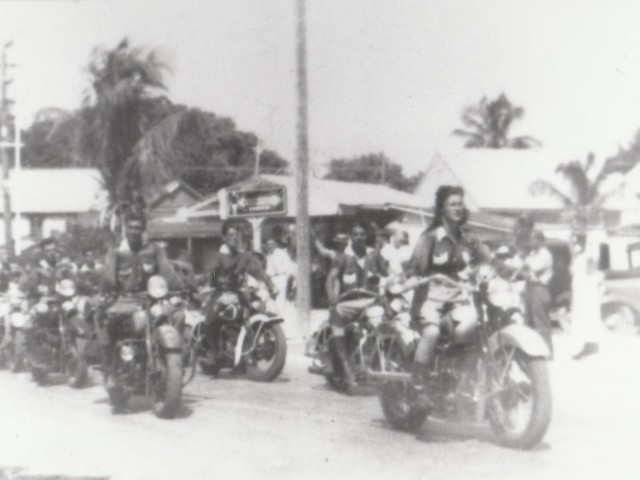
In various cultures, grandparents have been seen as a rich treasure. A grandparent’s life is one to be mined for the depths of riches shared in the form of unique stories.

One example was the late Winifred Ann Jackson Herzog, my own beloved grandmother. This is an account about how she led a motorcycle club across the $30 million Overseas Highway to Key West as part of the official opening ceremonies of July 2-4, 1938.

My grandmother was born in Richmond, Virginia, in May 1919. From her early years, Nana, as I called her, had many wonderful anecdotes which she shared before she passed in 2008.

Foremost among these was the role she played in the Key West festivities of July 1938. It was remarkable from both a historical and societal perspective. She helped Miami to do its part in carrying out a three-day holiday dubbed the “Gala Fiesta” in local newspaper accounts.

That year, the nation and particularly the Key West area was still suffering from the devastating effects of the Great Depression. The national unemployment rate was 19 percent. The morale boost from the manufacturing drive of World War II was just over the horizon as was the “Rosie the Riveter” campaign to promote contributions of women in shipyards and factories.

It was thus no small feat which occurred on Saturday, July 2, 1938, when my grandmother was 19. That day was when she set out to lead the Miami Motorcycle Club along with a special motorcade of city residents in making the trip from Miami to Key West. Nana rode the lead motorcycle, which was an Indian Four model.

Just how did she find herself leading this motorcade? As recalled by my family, Nana had met John Hays Long, my future grandfather, some months prior to this event. At the time, she had a job “hopping curb” at Pixie’s Ice-Cream Parlor. She served customers while wearing roller skates.

Nana had close friends named Thelma and Doris. Their brother, James, had given her a “basket case” motorcycle to take in for repair. The business she chose for service was none other than Long Motorcycle Sales in Miami. That is how she met John, the founding owner of the business and her future husband. (They would end up married the next year.) After meeting John, my grandmother grew interested in motorcycle club activities.

A few months later, local newspapers prominently featured the meticulous planning leading up to the three-day fiesta. The Miami Herald of July 1 reported that more than 1,000 people were expected to participate in the Miami motorcade sponsored by the Key West Club of Dade County. My grandmother led this group when they started out for Key West at 1 p.m. from the intersection of Northeast 55th Street and Biscayne Boulevard.

The Miami Daily News of July 2 reported: “This was the largest single motorized caravan expected to pass over the new highway during the celebration. Headed by a special motorcycle escort, the nomads of the open road traveled at a moderate pace through lanes of curious onlookers who assembled in the small communities along the route.”

In setting the context, it is important to consider details shared by my grandmother years later. In the 1990s, Nana told me that the motorcycle club members wore unique garb when you consider the perceptions of bikers in more recent times (such as the Marlon Brando look). Each club member wore a scarlet tunic or shirt along with khaki jodhpurs and riding boots.

Their mission was clear: to lead Miami residents in joining official ceremonies marking the occasion. This in turn provided a much needed “shot in the arm” for the state and nation. The festivities included inspections of U.S. and Cuban warships (with no cameras allowed), wrestling matches, a motorboat regatta, fireworks displays, and all-night dancing at a special “queen’s ball.” Amateur boxing matches were even held between Miami and Cuban fighters. The referee presiding over the fights was Ernest Hemingway.

Nana led the Miami motorcade for the approximately 130-mile trip from Miami to the awe-inspiring backdrop of the Bahia Honda Bridge, some 65 feet above the water. The ribbon cutting was held at 5 p.m. on July 2. The mayor of Key West, state and federal officials, and a representative from the Cuban government were in attendance. Bernice Brantley — the woman who had been previously designated “Miss Key West” — was given the honor of cutting a 60-foot, red, white and blue ribbon that stretched across the bridge.

The motorcade participants then drove the remaining 50 miles from the bridge to Key West, arriving there at approximately 6 p.m., July 2. As my grandmother resumed the lead position, more excitement awaited ahead. The Miami Herald of July 3 reported: “Led by members of the Miami Motorcycle club, the mammoth parade moved into Key West. From the entrance to the city limits on Roosevelt Boulevard down the broad expanse of this thoroughfare to Division Street and then on down to Duval Street the motorcade was greeted by a wild, cheering throng.”

The July 4 Herald reported that 10,000 people lined the streets to greet the motorcade. The importance of the festivities was underscored as follows: “Key West, once the state’s largest city, lost its importance years ago and its industries slipped away and was rendered destitute by the 1935 Labor Day Hurricane that destroyed the Overseas railway.”

Looking back now, it is interesting to note that Long Motorcycle Sales has continued to stay in business until this this day. During World War II, Nana helped to run the dealership with help from her father, William “Bill” Jackson. They kept the dealership running while Nana’s husband, John, served in the U.S. Army. In 1946, Nana and John were divorced. Today the business is located at 800 NW 12th Ave. in Miami and the family legacy is carried on by John A. Long, my uncle.

My mother Myrtis Virgina Bell came to Miami in 1913, her birth year, from Polk County. Charles and Virginia Bell, my grandparents, worked in a phosphate mine there.

In Miami, they successfully built houses in the Shenandoah area. They had two more children, Jack and Donald, before they divorced, leaving the three children for Virginia to raise.

Charles retired after building projects like the Miami Shores Country Club. Virginia struggled through the roughest part of the Depression. She sold crystalized citrus peels, avocados, or anything she could think of to provide income.

Virginia never learned to drive. Charles taught my mother Myrtis to drive the family car. She would drive her father to work, and then drive her mother on her errands, and then drive back to pick up her father.

She died at 98 in 2011, having retired from the University of Miami at 65 with the last mechanical typewriter on campus.

My first memory of my baby sister, Joan, was on my third birthday. We were introduced in Victoria hospital; she was born on the same day as I.

I started school at Riverside Elementary. I loved the Norman Rockwell setting, and looked forward to school. We moved into our new house at the edge of the Everglades: Southwest 63rd Avenue and two blocks off Flagler Street. I enrolled in Kinloch Park School for the third grade. It was a complete change. Most of the boys didn’t have shoes and they all had to establish a pecking order over me.

There was one classmate who rode the same school bus and delighted in throwing me out of whichever seat I picked. I learned to escape to our small community and still look on the neighbors as extended family. Originally, it was a planned neighborhood, with cast-iron lampposts and sidewalks.

The noises at night were a lot different than city sounds. There was a winter home for the circus, a hit-and-miss motor supplied the power for pumping water to the few houses scattered in the neighborhood, and early Sunday morning, a big cast-iron bell on the top of West Flagler Baptist Church would start ringing, summoning everyone to church. The original building had a baptismal pool behind the pulpit where I was baptized. My best buddy, Bruce, married his wife there, with me as his best man.

My mother attended Shenandoah schools in town but graduated with the first class of the new Miami Senior High School. My sister and I attended Kinloch, Citrus Grove School and Miami High.

My dad James Posey Boyer with only one ear drum was 4-F (classified unfit to serve in WWII). But he went to work as a machinist, first in Trinidad and later in Cuba. He helped establish U.S. military bases there at the beginning of the war. He and my mom opened a sundry store on the ground floor of a Masonic hall on Northwest 15th Avenue and First Street.

The Orange Bowl Stadium was just down the street. As a kid, I worked there after the games, picking up empty glass Coke bottles, where I got five cents for each crate. Competing with other kids, you really had to hustle to earn two bucks.

As kids, we camped out and fished on Key Biscayne, and even built a driftwood shelter on Fair Island. We could ride the bus all the way to the jetties for 10 cents. There were hundreds of vacant places for beach parties. In the summer, some hotel rooms were a buck a night. A birch beer and hamburger at Royal Castle was only 15 cents.

My dad used to take the family to Old Cutler, break an oyster-filled branch off a mangrove bush, build a fire, and roast it until the oysters opened. He would get us up early, catch a few fish and cook them on an open fire, for breakfast on the beach. Fish was a large part of my family’s diet. I now realize it was readily available and cheap.

I had a paper route, and I used a chicken crate to carry the papers. I started at 52nd Avenue and Flagler and went north to the Tamiami canal, all the way to the Flagler Street Bridge and Milam Dairy Road with only 110 customers.

Every year we made a trip to Pompano to find a Christmas tree, imagining them standing upright, because all the short needle pines were bent over to the west from the constant wind off the beach. Several times during the war we heard about a ship being torpedoed and on fire, and we would go to the beach to watch.

I got my first bike at 9 and gave it away after high school, when I had to report for basic training. The USAF 435th was activated at the beginning of the Korean War. I dream about those times in early Miami, and for sure I lived through the greatest time in history, in the greatest town God ever created.

She died at 98 in 2011, having retired from the University of Miami, at 65 with the last mechanical typewriter on campus.

My first memory of my sister was on my third birthday, being introduced in Victoria hospital, to my baby sister, Joan born on the same day as I. I remember being taken across the street from our apartment, in 1935, to spend the night in a bigger building; because a storm was coming; and then sleeping through the whole thing.

I started school at Riverside Elementary. I loved the Norman Rockwell setting, and looked forward to school. We moved into our new house at the edge of the Everglades, Sixty-Third Avenue and two blocks off Flagler St. I enrolled in Kinloch Park School for the third grade. It was a complete change.

Most of the boys didn’t have shoes and they all had to establish a pecking order over me. A couple of the more infamous attending were the Cash brothers; and the one who made my life the most miserable was later known as Long John Fulford. He rode the same school bus and delighted in throwing me out of whichever seat I picked.

I learned to escape to our small community and to love our in their small houses, and still look on the neighbors as extended family. Originally, it was a planned neighborhood, with cast iron lampposts and sidewalks. They never paved the streets because of the crash in 1929.

The noises at night were a lot different than city sounds. There was a winter home for the circus, a hit-and-miss motor supplied the power for pumping water to the few houses scattered in the neighborhood, and early Sunday morning, a big cast iron bell on the top of West Flagler Baptist Church would start ringing, summoning everyone to church. The original building had a baptismal pool behind the pulpit where I was baptized pre-teen.

My best buddy Bruce married his wife there, with me as his best man. My mother, Myrtis Virgina Bell, attended Shenandoah School and High school in town but graduated with the first class of the new Miami Senior High School. My sister and I attended Kinloch, Citrus Grove School, and Miami High.

My dad, James Posey Boyer, (with only one ear drum), was 4-F; but he went to work as a machinist, first in Trinidad and later in Cuba. He helped establish US military bases there at the beginning of the war. He and my Mom opened a sundry store on the ground floor of a Masonic Hall on NW 15th Ave and 1st street.

The Orange Bowl Stadium was just down the street. As a kid I worked there after the games, picking up empty glass coke bottles, where I got 5 cents for each crate. Competing with other kids, you really had to hustle to earn 2 bucks.

As kids, we camped out and fished on Key Biscayne, and even built a driftwood shelter on Fair Island. We could ride the bus all the way to the Jetties for 10 cents. There were hundreds of vacant places for beach parties. In the summer some hotel rooms were a buck a night. A birch beer and hamburger, at Royal Castle, was only 15 cents.

My dad used to take the family to Old Cutler, break an oyster- filled branch off a mangrove bush, build a fire, and roast it until the oysters opened. He would get us up early, catch a few fish and cook them on an open fire, for breakfast on the beach. Fish was a large part of my family’s diet. I now realize it was readily available and cheap.

I had a paper route, and I used a chicken crate to carry the papers. I started at 52 Ave. and Flagler and went north to the Tamiami canal, all the way to the Flagler Street Bridge and Millan Dairy Road with only 110 costumers.

Every year we made a trip to Pompano to find a Christmas tree, imagining them standing upright, because all the short needle pines were bent over to the west from the constant wind off the beach. Several times during the war we heard about a ship being torpedoed and on fire, and we would go to the beach to watch.

I got my first bike at nine and gave it away after high school, when I had to report for basic training. The USAF 435th was activated at the beginning of the Korean War. I dream about those times in early Miami, and for sure I lived through the greatest time in history, in the greatest town God ever created.

The year was 1950. My parents, Bernice and Eddie Melniker, came to Miami because my dad had purchased a drive-in movie theater, the Coral Way Drive-In.

They settled in at the Brickell Point Apartments, right on the river, and I was enrolled in the Lear school, then located on West Avenue in Miami Beach. It was not long before they purchased a new home on Hibiscus Island, where they remained until 1985, when they sold it and moved to Morton Towers.

My dad had always been a member of and involved in the Variety Clubs in different communities, so it was only natural that he would look them up here in Miami. At that time, they were the sponsors of Variety Children’s Hospital, and their main goal was to raise funds to maintain the hospital. This was in the days when polio was prevalent and the hospital played a large part in the program here in our community.

Since my mom was no longer working, as she had for so many years in her parents’ business, she was looking for something to fill up her time. When she met the ladies of the auxiliary, or as they called it in those days, “The Women’s Committee,” a perfect match was found. She was a very shy, southern lady, who had never set foot in any type of organization, but magic happened.

Her life became dedicated to this cause and she went head first into the task. This was her goal and a shining star was born.

Her first effort was to start up the Candy Stripers, young teenage girls who would become volunteers at the hospital. The red and white stripes appeared all over the hospital and were soon an integral part of the hospital’s volunteer staff.

Later, while serving as president of the organization, she traveled all over the state and even became president of the State Hospital Volunteer Organization. But her heart was always here in Miami and her efforts continued. How wonderful it was when the hospital expanded and became known as “Miami Children’s Hospital,” well known all over the world.

When she and my dad traveled around the world attending Variety Club conventions, she was always called to speak regarding the volunteer process, and she was a pro at this. The ironic part is that before moving to Miami, when her brother, Harold, lived with them, he was a major part of the ham radio community, speaking to people all over the world and particularly instrumental in offering their services when there were natural disasters. He would be talking to someone in Australia, she would come into the room and he would offer her the microphone to say hello to them, but she ran from the room in extreme distress and shyness. Hard to believe, because as the years progressed and her work with the hospital increased, if there was a microphone anywhere around, she would have it in her hand. I remember that we may have put one in her casket when she died.

Her accomplishments were amazing. She planned, hosted and presented many affairs and events, but probably the best one and her favorite was the “Golden Harvest” luncheon at the Fontainebleau, which she masterminded for 37 years. I know this because I worked along with her. She created the program, wrote the plans, produced and directed this affair, and then allowed me to host the event. They were glamorous, spectacular, fashionable affairs and they brought in the most prominent socialites to attend and participate in the fashion shows. As time went by, they included an adjunct to this famous luncheon, calling it “Golden Harvest Queen of Hearts,” and each year they would honor a special lady from the community.

By now, you might be wondering where my dad was during all this. Well, he was Mr. Miami Beach. Having gone from the theater business to banking, he made his mark with just about every organization in town. Walking down Lincoln Road with him was an adventure in itself, and it seemed everyone he passed was a customer at his bank. First, there was Mercantile at 420 Lincoln Rd., then Pan American at the Roney Plaza, then SunTrust, which was the last before his retirement. But the word retirement did not fit with either of my parents. He played golf at many courses, cards at the Elks club, but never leaving his true love for the Variety Clubs and their many projects helping children. He died in January 1986, at the age of 85.

They were a gorgeous couple attending so many social events, but always wearing proudly their banner of services to Miami Children’s Hospital. These memories will linger forever with me, and if you happen to visit the gift shop at the hospital you will see my mom’s plaque on the wall just by the door. The last “Golden Harvest Queen of Hearts” was held in November 2000, and at the next monthly meeting, Dec. 20, they gave her a big cake.

While at this luncheon, she was already speaking about plans for the next event for November 2001. One week later, she passed away in her sleep, with no fanfare, just a quiet goodbye. So, the curtain went down, the lights dimmed, but her special talent and dedication to something in which she believed so magnificently will remain.

The road trip began in northeastern Pennsylvania and ended in Miami, Florida, in August of 1985.

The plan was two years of grad school at UM for my spouse and then back home.

Seemed like a doable plan. We took an apartment at Red and Bird Road. We walked to Allen’s Drugstore for breakfast. Walgreens and Piggly Wiggly were there to make life easy.

The semester began at UM. Kenton was a teaching assistant as well a doctoral candidate. He was engaged in scholarly activities. I explored.

Kenton came from a dance and musical family; his brother had moved to Miami years earlier and operated a dance studio at 114th and Bird Road.

Teaching at the dance studio provided additional income and involvement in the arts. I did a stint at their reception desk for a short time, passed out samples in a supermarket and did telemarketing at the Coconut Grove Playhouse, transitioning to special events. Great fun and interesting people.

When Thanksgiving rolled around we found ourselves having dinner outdoors in a garden. We marveled at the streets lined with palm trees. (Still do!) Shortly thereafter, wearing shorts, I sang “Here comes Santa Claus” with other parade goers on Sunset Drive in South Miami. I enthusiastically drove out-of-town visitors around — the beaches, Coconut Grove, Calle Ocho, Dadeland Mall and the Everglades.

In anticipation of the move to Miami I had subscribed to the Miami Herald, voraciously reading about this temporary home. The thing that I found to be particularly intriguing was an article about a new project which would provide studio space for artists to work. It was called the South Florida Art Center and it was located on Lincoln Road in Miami Beach.

I had a degree in art education but had worked in retail management in Pennsylvania for ten years. There were no art classes in my small mining town high school. No art lessons; my first visit to an art museum was as a sophomore in college. I yearned to be an “artist.”

So off I went to find this “Lincoln Road” which surely, I thought, would be made of yellow bricks!

The street was sluggish, devoid of any references to our idea of the energy depicted in Miami Vice. Empty cavernous storefronts, small haggard businesses. Disquieting.

I remember sitting in a temporary office. Across the desk was a woman named Ellie Schneiderman, an incredible visionary willing to do the deed no matter what it took. And the deed was to give artists a place to work in commune with each other and the community. It was a dingy and dark loft space and I was scared to death. By the time the interview had ended I was officially an artist at the South Florida Art Center!

Over ten years I changed studio spaces three times. I exhibited at the Art Center and many venues in South Florida, the Northeast, as well as Costa Rica and California. The South Florida Art Center had become my art school. The other artists were integral to my growth as an artist. We shared, critiqued, tossed ideas around and socialized with like-minded new friends who offered many different perspectives and cultural histories. In those early days we literally owned “The Road.” It was magical.

I was also blessed to have several mentors during this time. One, an accomplished printmaker, taught me many techniques, offered advice and shaped my view of the importance of process in the making of art as integral to the completed piece.

Another introduced me to the tradition of hand papermaking. I had no clue that paper could be made in one’s back yard or indoors in a studio, your laundry room or your kitchen counter (on a smaller scale), using fabrics and plants to produce the pulp necessary to make sheets of paper. After learning and creating my own paper pieces I actually traveled to Costa Rica to exhibit and participate in a workshop where we made paper from local plants.

Kenton enjoyed his UM days as well as teaching and performing dance. He participated in the dance segment presented by Disney for a Super Bowl game. Definitely a fun time.

These were but a few of our wonderful experiences. It has been a glorious time for us.

Kenton did complete his studies at UM and began to teach as an adjunct at Barry University, St. Thomas University, UM, Miami-Dade and Florida International University.

After almost 30 years I guess we’re staying.

Coincidentally, this year is the 30th anniversary of the South Florida Art Center, now known as ArtCenter/South Florida.

I continue to make art in a studio in the Bird Road Art District and Kenton is a professor of philosophy at FIU.

My thanks to those who have written of their beginnings in South Florida. Their memories have kindled long dormant, almost forgotten, ones in me. And that is a good thing.

Although I was born in the 1940s at Jackson Memorial Hospital, my paternal grandmother, Clara Belle Thomas, and her husband came here from Louisville, Kentucky, in 1925. Great fear, following the destruction caused by the 1926 hurricane, caused her and my grandfather to return to Louisville that same year. But, with Miami “sand in their shoes,” they returned in 1927, this time buying three rental houses, one of which was where the Omni now stands.

Because of the stock market crash in 1929, their renters lost their jobs, couldn’t pay their rent, and the bank repossessed all three houses. While the whole nation went into depression, my grandmother fed her family Campbell’s tomato soup for quite a while.

When she could, she worked as a seamstress at the downtown Burdines and my grandfather drove a street car from Flagler Street north on Miami Avenue to NW 36 Street, which then was on the outer fringes of the city. They saved their money and, in time, bought a property on NE 52 Terrace. Their children, one of them my father, went to school at Lemon City High School, now Edison High.

I was told that in the mid-1940s, visible maybe ten miles off Miami Beach, were explosions from allied ships being sunk by German submarines (U-Boats). My father, John G. Thomas, taught law to troops training on Miami Beach and later, for several years, was an assistant city attorney for the City of Miami.

On Saturday mornings in the 1940s and 1950s, we saw cartoons and serial shorts, like Flash Gordon, Hopalong Cassidy, and The Lone Ranger in theaters. For twenty-five cents we sure got our money’s worth. My parents purchased a black-and-white TV set in the early 50s and we couldn’t wait until 9 p.m. on Monday nights to watch “I Love Lucy.” Color TV first came in the form of a multi-colored sheet of acetate which we placed over the black-and-white screen. How neat was that?

Taking a blue and silver bus from the Gables Bus Terminal, then located on the corner of Ponce de Leon Boulevard and Miracle Mile, and traveling to downtown Miami was great fun and safe as can be. I can still taste the fifteen-cent burgers at Royal Castle which were made with real meat and real chopped onions.

My school years were spent at Coral Gables Elementary, Ponce de Leon Junior High, and Coral Gables Senior High School. Cotillion, during sixth grade, was held in a room next to the Coral Gables Library, which then was on the north side of the city. It prepared youngsters in dance and etiquette and was taught by Mr. and Mrs. Rodney Novakowski.

The etiquette was really just common manners. Part of the “dress of the day” was the dreaded crinoline, a starched half-slip worn to help our skirt stand out. Marbles, anyone ever hear about playing marbles? They were the rage in the early fifties. These were simpler times.

In the early 1950s in elementary school, in addition to fire drills, we learned how to react to an air raid warning: go under our desks and place one arm behind our neck and the other across our forehead. The Korean War had made everyone more alert.

In junior and senior high school, I learned how to play a clarinet and marched in many Orange Bowl and Junior Orange Bowl parades. The community of other band members became a family away from home.

An unexpected plus came in 1959, when a rather pedestrian clarinetist – me – was given a scholarship to the University of Miami Band on the Hour, with Fred McCall directing. “Hail to the Spirit of Miami U.…”

It was then, in the band, that I met my future husband, John C. Adams, Jr. Tuition was $395 a semester. One day, between classes at the “U” in 1962, I looked south and I saw army troops and big guns in a caravan of vehicles heading south on Dixie Highway.

This was the beginning of the Cuban Missile Crisis. The United States, led by President John F. Kennedy, demanded that Russia remove their missiles from Cuba, only 90 miles from the US mainland. Thankfully, this face-off was successful.

In 1963, armed with a bachelor’s degree and a few Spanish phrases, I got a job with Pan American Airways, Latin American Division, based in New York, and flew to South America and the Caribbean. In the winter, leaving New York, I’d be dressed in a calf-length coat over my uniform. Three and a half hours later, when I’d deplane in Caracas, Venezuela, it was summer.

In 1965, John and I were married, and in time had two children, Nancy Adams, a speech pathologist and Andrew Adams, a civil engineer.

It is said, “adversity brings maturity.” If that is true, then South Florida came of age after Hurricane Andrew. People of all ages volunteered to help in any way they could. When I volunteered to help, I was given an orange vest and a whistle and told to report with another lady to the intersection of Miracle Mile and Douglas Road in Coral Gables. There we would direct traffic for several hours.

We were not alone, though. As people drove by they would say, “Thanks,” and hand us an ice-cold drink. The next day I was sent south on Dixie Highway to a Salvation Army make-shift tent headquarters. There we opened and distributed contents of aid boxes sent by tractor-trailers from all over the country. I opened one box from Ohio which had a hand-written note placed on the top that said, “we are praying for you.” Then I knew we were part of a bigger community than I ever imagined, the United States of America.

For the past 20 years, John and I have been private investigators, licensed by the State of Florida.

All these years have been such a hoot! When I read this it sounds like I’ve been a part of history. Ours is a “fairly young” community and before you know it, you’ll be a part of history, too. I am blessed to live in a great city and a great nation.

I have called Miami home for 82 years.

Sometimes I feel like “The Last of the Mohicans” because there are so few native born left.

I was born in 1927 at Victoria Hospital. My husband Pete Williams also was born that same year, but we grew up in different neighborhoods so never met until high school days. We both had parents who came to Miami in the early 1900s — his from Tennessee and mine from Illinois and Georgia.

After dating all through our Miami High days, he went to the U.S. Naval Academy and I went to Florida State University in 1945. We both graduated in 1949 and then married in 1950 — after I taught school for a year and he served in the Navy. We’ve been married 59 years and have three wonderful daughters. God has blessed our family!

I have always wanted to honor my grandfather, James E. Crammond, and grandmother Lula Harry Crammond, as they were pioneers who came to Miami in 1912. They were both born in Gibson City, Ill.

As a boy my grandfather helped his father in the grocery business and learned the art of proper display of foods.

When he came to Miami seeking a warmer climate for his family and since the grocery business was all he knew, he established his first store on Avenue “L” or Seventh Avenue (as it is now known) and 10th Street. Within four years he had a chain of six stores.

Then he realized that he could better utilize his talents with a consolidated store so the White House Grocery was born.

It was one of the first, if not the first, supermarkets downtown.

He was the first to introduce the “cash and carry” system in Miami — and possibly Florida. He said he had never seen the system anywhere but with the coming of the war, employees became scarce and expenses ran high so he had to diminish both. The plan was a success!

The White House Grocery was located on North Miami Avenue between Fourth and Fifth Streets. His only son, my father Emert Crammond, worked for him and he loved to take photos from the store’s rooftop. He was so excited to see Miami growing, the first causeway being built to the beach and the Miami News Tower growing tall on the boulevard.

Then the 1926 hurricane came along and ruined everything, including my father’s pharmacy, which he had just opened. He and my mother, Sarah Jones Crammond, married in 1925. Then the 1929 Depression hit. Everyone was hit hard.

My grandparents decided to tear down their home on Northwest Seventh Street near 12th Avenue and build the 12th Avenue Curb market, their last store. Sadly my grandfather died of the flu in 1937 but the Curb Market survived for about 10 more years.

I am proud of my loving grandparents and parents. My grandmother died in 1949, my father in 1977, and my mother in 2001.

We must never forget the people who came before us and made Miami what it is today.

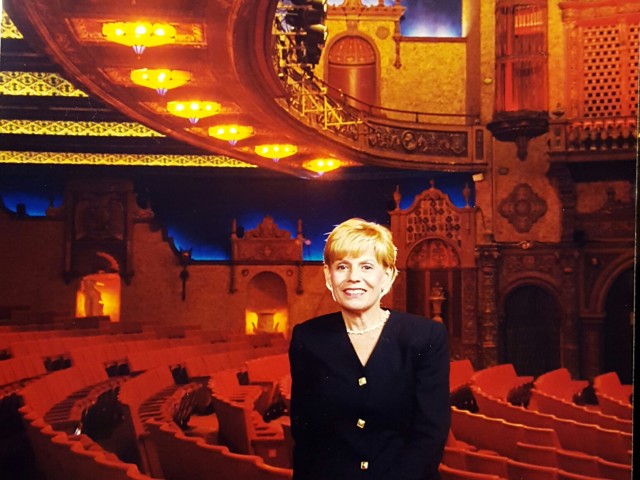
In the 1920s, the film industry was beginning to invest in “sound” for movies. Impressive theaters were built and audiences came rushing to escape the reality of life. Movies and vaudeville drew thousands of people to these spacious, elegant buildings known as movie palaces, and Miami was no exception.

The Olympia Theater was one of them and she was the heartbeat of downtown Miami. Her lights were brilliant and kept their sparkle through the economic and natural crises of the times from the energy left by the many performers and stars who graced her stage.

Then the glamour and excitement vanished. The dazzle of the movies and the up-tempo of the vaudeville acts no longer thrilled the crowd. The stock market crashed in 1929; the ‘30s saw a hurricane disrupt the lives of Miami audiences. The Olympia’s seats were empty; the audience was gone. The halls were dark except for the ever-present traditional, single bulb, caged in steel standing near center stage and left to burn eternally. This light–the soul of the theater– never goes dark.
It is called the “ghost light.” There is a superstition connected with it that says a spirit floats through and haunts every theater, even Miami’s Olympia Theater. I know it exists.

With all its problems, the Olympia was destined to become a parking garage until millionaire businessman Maurice Gusman bought the theater, saved it from the demolition ball, and it became Maurice Gusman Theater, Center for the Performing Arts.

The theater’s rebirth began and the lights returned brighter and stronger than ever before. I came to Gusman as a Florida International University intern in the 1980s. Upon graduation, I was hired as an assistant to the managing director. I began my dream job on December 26, 1984. Downtown was quiet but I was intoxicated with excitement. This same feeling led me through the next 20 years of my life in a job I loved. Yes, it was filled with long hours but I gained priceless experiences, as well. I also discovered the value for details and contractual requirements unique to major stars. I reveled in the personal moments with these major stars, which I was privileged to see.

I like to call this “my Renaissance period” for it was that for both my beloved theater and me. It formed a lifetime of love for me and a rebirth for the theater as Miami audiences begged for a stage for world performers.

Edward Villella gave birth to the Miami City Ballet, forming a ballet company with local talent and New York dancers with a full week of performances; Michael Tilson Thomas auditioned musicians from all over the world to come to Miami to be a member of a teaching orchestra, the New World Symphony; and my boss created programs for the season of traditional jazz performers, such as Marian McPartland, Dave Brubeck, Ramsey Lewis and Carmen McRae to note a few. These programs brought music lovers to downtown to the corner of Flagler Street and 2nd Avenue.

I loved going to downtown Miami even though everyone told me how frightening it was. Strangely, I never felt threatened by the street people. I felt sadness for them but never fear. The dark streets and empty store-fronts did not intimidate me, nor did the dark of the theater. The “ghost light” was always on so I could stand at the top of the mezzanine balcony and look all over the theater as the light created unique shadows throughout this exquisite atmospheric theater designed by John Eberson in l925. The single stage light cast dramatic shadows on the proscenium arch making the sculptured faces and the carved stone gargoyles grotesque and macabre.

Remember I mentioned the “spirit that floats through and haunts” every theater. The reason I know it exists is because I did see it. Laugh if you will but I did. Here is what happened:

My boss loved to drop last minute projects with immediate deadlines on my desk to see if I could manage it. It was Friday at 4 P.M. He picked up his briefcase and as he left the office rushing down the back staircase of the theater foyer, he said “don’t forget, you have to feed the dance company on Saturday night two hours before show time. See ya.”

What was that? I yelled as I came out of my concentration over a contract and ran to the top of the stairway only to see his 6-foot tall body slip out into the backstage alley. As the door slammed shut, and I started back into my office I thought I heard something or someone but I knew I was alone in the theater. I stopped at the doorway, listening for a familiar sound but there was only the silence of the theater. Then a swath of light floated through the chandeliered balcony foyer making its way up the stairs to the mezzanine. I was not frightened. I was inquisitive. I believe buildings and houses have “energy.” I looked for reflections from 2nd Avenue traffic but there were none. I believe this kind of energy manifests itself in some way, especially if you are sensitive to its existence. I saw the spirit that floats through our theater. I never saw it again but what a beginning.

I love the theater, I love the ghost, I love the audiences and I loved my life at Gusman Center for the Performing Arts, now The Olympia Theater again.

The homeless man knocked on my window while I was stopped at a red light on North Federal Highway, just east of the Miami Design District. He made the motion of hand-to-mouth, the one that says, “Feed me. I’m hungry.”

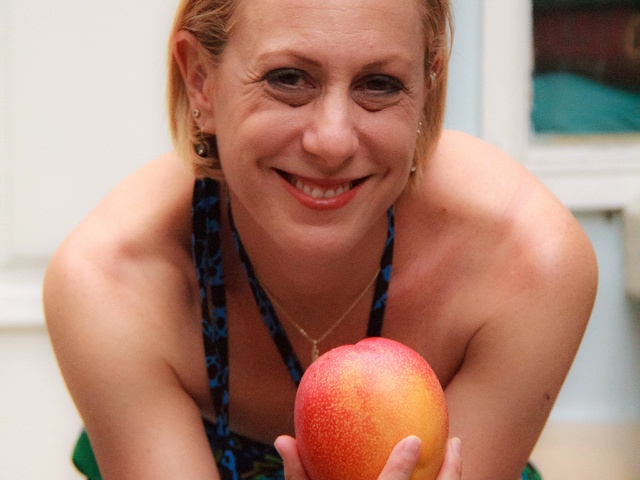
It just so happened that it was June, and in the middle of a heavy mango season, when eight of our 14 trees were throwing fruit at me as if we were playing a long, continuous and particularly juicy game of dodge ball. Because I never go anywhere without them, I had several Publix bags filled with fruit on the seat beside me. I rolled down the window and handed him one, bulging with the aromatic globes.

He was about to thank me when his expression turned suspicious. The overwhelming perfume of dozens of mangoes shot out of my car window along with the air conditioning. “Wait,” he said, “what are these?” He looked inside and his nose wrinkled. Then he handed the bag back to me. “No thanks. I don’t like mangoes.”

The light turned green at that moment and, with Miami’s notoriously impatient drivers honking at me, I didn’t have the opportunity — or, at this point, the charity — to explain that while he might be one of the few people in South Florida to disdain the world’s favorite fruit, perhaps he could trade them on the street for something else. I just shook my head and drove off.

This anecdote popped into my head when I woke up one recent morning and discovered a criminal act had occurred on my property the night before. Someone had stolen all the guavas from my tree, fruit that were still hard knobs of verdant acidity, but would any day begin transforming themselves into softer, sweeter and kinder versions. My dog walker, Jorge, and I were keeping a close watch — there were about 75, maybe more — waiting for that first tinge of yellow and hint of distinct aroma, caught somewhere between cat pee and tropical mold (but closer to cat pee).

Our vigil was for naught, because my tree has apparently been marked for a while now, and every harvest I’ve almost had for the past two years has magically disappeared. Worse, this time, the thieves didn’t just pick the fruit. They ripped off entire branches, the main arteries where the guavas had proliferated most, rather than take the time to tug them from what would have been, surely, their unforgiving stems.

Several weeks later, I came home from a weekend away to find that all of my low-hanging, early-ripening avocados had been taken as well.

Posting my losses on social media, I learned in response about the rumored “mamey wars” in the Redland region, where mamey sapote is so treasured that it has to be grown under guard. I heard about a fellow Miami Shores resident’s jackfruit tree, which was robbed of its Dali-esque fruit at 2 a.m. one night (a neighbor on a night shift caught the perpetrator in the act). I was given lots of recommendations about planting away from front yards and fences, and suggestions on how to espalier young trees so that they’re less of a target for the drive-by, rip-off artists who sell ill-gotten nighttime gains to fruit cart purveyors. It’s all good reasoning and sound advice, except that it comes far too late.

On the other hand, mango season is so prolific I wouldn’t notice if 500 pieces of fruit took a walk one day. I’d actually probably be grateful. But that rarely happens. Even the mango trees on the nearby properties that have gone into foreclosure remain untouched, the fruit decaying into the ground.

Indeed, as much as mangoes can foster love and lust during the first of the season, by the middle or end no chef, neighbor or homeless person within miles wants to catch a glimpse of me. I was even denied entrance to the Sunday poolside brunch at Hyde Beach in July this past year, where I was bringing mangoes for the kitchen, because the security staff considered them on par with groceries. As in, per the Terminator dude at the velvet rope (yes, for brunch, an element I’m still trying to figure out): “You can’t come in here with a bag of food.”

“No, you don’t understand,” I said. “I have a reservation for brunch, and I brought these mangoes for the kitchen.”

“No entrance with a bag of food.”

“This isn’t ‘a bag of food.’ These are beautiful, tree-ripe mangoes. From my trees. Picked by me. For the chef.”

No one asked for my reservation name, called for a manager or even bothered to turn around to talk to me directly, although it was obvious that they did consider me a middle-aged idiot. Very slowly, the same man said, “Ma’am, we don’t allow outside food to be brought in.”

I was, by now, angry and exasperated, not to mention hot, holding twenty pounds of mangoes in July and arguing at a velvet rope to a venue where I had been invited by the public relations firm for brunch. “Really, it’s not like these are potato chips. I hand-picked these for the chef. It’s mango season. Backyard growers like me do this. Trust me, it’s a Miami thing.”

“We don’t have a chef.”

Check and mate. I left the premises because, well, who would want to eat brunch there anyway?

But along with the lesson of not accepting brunch invitations at what is essentially a club, in Miami, I have learned, some kinds of fruit are valuable currency. (I wonder, had I been holding guava, would Hyde Beach security have parted the Red Sea for me?) Yet those fruit that are plentiful and common, no matter how well-loved, are like the old Italian lira: inflated, worthless. And at the height of season, you can’t even give them away, not even to those who have nothing at all. Including, it seems, a chef.

I was born in Hamburg, Germany, in 1941, during World War II. My father had a sister in New Jersey who sponsored my parents and me to come to the United States. Due to the quota at that time, we had to wait five years to get permission to immigrate. My parents were only allowed a certain amount of money to bring into this country, so we came first class – it was a glamorous ship. Unfortunately, I was seasick most of the cruise. We left April 4, 1952, and arrived on April 15. This April was so stormy our arrival was delayed by two days.

We finally made it to New York and went past the Statue of Liberty. We were all so excited. My aunt and uncle picked us up and we drove to Demarest, New Jersey. My parents went to night school to learn English and I was enrolled in the public school.

Demarest was a small town, and they had never had a foreigner in the school, so they had no clue what to do with me, not knowing English. I was placed in first grade – mind you I was 12 years old – and I felt terrible being there. My aunt helped me learn English at home after school with tools the school gave her. After a few months I was placed in the correct grade.

In 1956 we came to Miami Beach for a vacation and loved it so much that we moved here in 1958.

I worked as a hostess at Maisel’s Restaurant, then known as Junior’s Restaurant, on the corner of 79th Street and Biscayne Boulevard. Having come from up north, I could not believe that the restrooms and water fountains were segregated; “White” and “Colored” signs were placed on them. This restaurant, like Wolfie’s, was very popular. We used to have long lines.

In 1961, I was fortunate enough to be hired as a flight attendant with National Airlines until 1992, when I was made a supervisor of flight attendants for seven years. When Pan American acquired National, I was a purser for them until 2002. I loved all 30 years of flying and looked forward to every trip. My daughter is a flight attendant with Delta and also loves it. My son is in New York becoming a lawyer.

It was a big shock when Pan Am went out of business, and I had to find a new career, which turned out to be in the hotel industry. I became a manager of housekeeping for the Seaview Hotel, then the Grand Bay Hotel, and then Fisher Island. Then I was fortunate enough to receive a call from Royal Caribbean and asked to be a facilities consultant. I traveled to all the ships to teach cleaning and equipment use. Unfortunately, due to the economic situation, several of us were let go.

As you can see, Miami has been very good to me and my parents. “Thank you” to the USA for having accepted us, and allowing us to be able to live here in this great country.

Translate »