Skip to content
Named Best Museum 2022
by Miami New Times

One of Jean McNamee’s first memories as a child in Hollywood was of her mother, Elise La Monaca, putting her and her brother in the family’s icebox.

Her father, Caesar La Monaca, calmly assured his wife that everything would be alright, but Elise was afraid the roof would come off the house or that the rising flood water would overtake them.

Caesar peered out of their East Hollywood home on Sept. 18, 1926. In the shadows of the stormy morning he saw images he would recount for the rest of his life: Large objects floated haphazardly through his neighborhood. Cars were being pushed by powerful winds and waves through the streets, as if being driven by frenetic children on a bumper car floor.

The Great Hurricane of 1926 killed many people on its path of destruction. What La Monaca couldn’t have realized that day was that the winds of that storm would change the direction of his career and his life. It would end up pushing him towards Miami, where he would become the city’s authentic “Music Man.”

La Monaca was born in 1886 to a shopkeeper father, Vito, in San Severo, near the heel of what is the Italian boot. His mother, Giovanna, raised six children.

He was born Cesare, which he Anglicized to Caesar in America. He followed his older brother, Giuseppe, who later changed his name to Joseph, into the Banda Bianca, an Italian community band in which new band members were apprentices, studying music theory as well as instrumental techniques until they were good enough to play with the group.

After Joseph earned a flute-playing job in Ellery’s Royal Italian Band, a touring group in the United States, he found a spot for Caesar as a horn player.

The La Monaca brothers immigrated and traveled America’s booming heartland, playing concerts, festivals, fairs and any event that would hire them.

As America entered World War I, La Monaca was drafted. His expertise in music was discovered and he was made the enlisted bandleader of the Camp Kearney band, in California, while serving in the 82nd Infantry Division. During those years he transitioned from musician to bandleader.

The war wound down before he was deployed and La Monaca moved back to the Northeast, where he worked on Broadway and in vaudeville. In New York, he met a beautiful young Italian immigrant, Elise D’Addona. She was 15 years his junior but Caesar proposed on their first date and they were soon married. The La Monacas soon had two children, Caesar Vito and Jean.

Joseph La Monaca moved to Philadelphia, where he began a prestigious career as flautist and composer with the Philadelphia Symphony.

Ceasar La Monaca brought his band to Florida in 1923. With six new houses starting construction daily, developer J.W. Young’s Hollywood was exploding with residents and they needed entertaining as much as the tourists in Young’s hotel. Young hired La Monaca full-time. By 1926, Hollywood had a bandshell, an outdoor stage at the casino, and countless other venues for live music. La Monaca even formed a marching band to participate in Hollywood’s first Fourth of July parade.

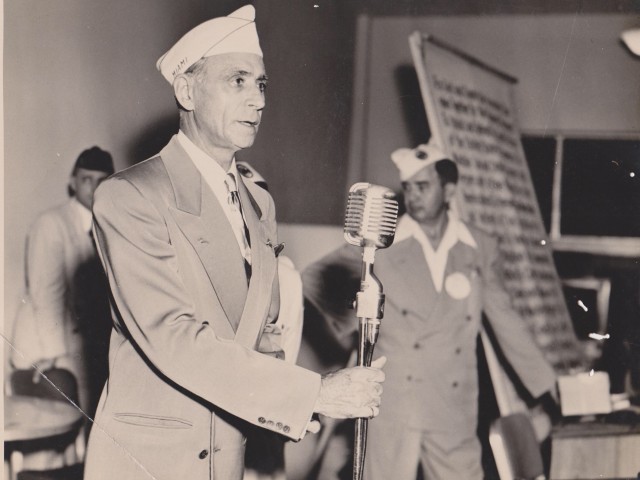
Soon after the Great Hurricane, Hollywood’s economy floundered and La Monaca had to look for work elsewhere. He joined the American Legion as musical director for Harvey W. Seeds American Legion Post #29 drum corps. The corps already held a national championship. La Monaca would lead them to three more national championships and countless state championships as well as international accolades over the following 25 years.

La Monaca soon won the job producing seasonal concerts at Miami’s Bayfront Park. His free concerts became a social staple, with thousands in attendance at almost every show. He attracted guest soloists like the famed Mana-Zucca and local John Basso. He introduced thousands of music fans to classical songs he arranged from memory. His bands also played popular songs and even some of his own compositions. La Monaca wrote several songs about Miami.

He was always teaching music and bringing good musicians together. He incorporated members of the 265th Coast Artillery band of the Florida National Guard band, where he was the bandmaster, and students from the University of Miami, into his shows.

During the Great Depression, La Monaca, through the Works Progress Administration (WPA), was able to get unemployed musicians to teach music to his drum corps.

It is impossible to count the thousands of young men and women La Monaca trained over the years. He and Miami Sheriff Thomas Kelly, a fellow Legionnaire, launched the Miami Boys Drum and Bugle Corps for younger boys. Even after they retired from the marching field, they helped guide the development of the Miami Vanguard and Legion of Brass drum corps. La Monaca taught Boy Scout drum corps in Miami and Hollywood. He organized the predecessor to the Greater Miami Youth Symphony.

Daughter Jean McNamee recollects one Orange Bowl parade in which her father marched the route five times. As soon as he would get to the finish line, a police escort would take him back to join another of his marching bands or drum corps.

From 1926 to his death in 1980, La Monaca’s bands were everywhere in Miami: His band opened the horse track at Tropical Park in 1931 and played there and at Hialeah race track regularly. In 1933 his band was at Bayfront Park during the attempted assassination of President-elect Franklin Roosevelt.

During World War II, La Monaca was too old to serve. He was forced to retire from the military. He joined the all-volunteer Florida State Guard and helped the sales of war bonds.

He worked tirelessly in the industry that brought him joy and success. He was a musician, composer and a respected conductor. La Monaca, an Italian immigrant whose life began under adverse conditions, arranged his way to the American dream as Miami’s Music Man.
World War II was over, but not for my father, U.S. Navy Commander Charlie Houghton. There was one more job for him.

He was placed in charge of decommissioning and restoring the hotels on Miami Beach that the Navy had used. During that time, my father worked with two of the hotel owners. They liked the job he had done and hired him to work for them. They owned Westview Country Club in North Miami. They thought it was too soon after the war to reopen the Westview. Their idea was to open a trailer park on their golf course. They wanted my father to start it up and manage it.

It was exciting to live in a country club. Our living room was large enough to set up a volleyball net and play a game. The country club itself was built on a hill surrounded by beautiful green grass.

We were there for just a week when a hurricane hit. We Houghtons knew nothing about hurricanes. My father and mother gathered all eight of us kids into the main living room and we stayed there until the storm was over. The surrounding land and roads were flooded. It wasn’t unusual to see someone rowing a boat up Northwest 119th Street. When the water finally subsided, one of our neighbors drove up in his truck to show my dad the rattlesnake he killed in his yard. My six brothers gathered around the truck to see the rattler. My sister and I hung back and saw it from afar. IT WAS BIG.

My dad and older brothers, Tony and Jimmy, worked together to get the trailer park up and running. The boys learned a lot that summer about electrical, water and sewer hook ups. They built it and “the people came.”

My new friend, Bessie Crocker, lived across Northwest 119th Street. Her mom and dad owned and ran a restaurant named The Blue Yonder. The restaurant was only open for dinner. One day, Bessie’s mother made us a lunch of delicious German noodles and let us eat in the dining room. She was a wonderful cook and nice lady.

Behind the restaurant was a huge cow pasture. Bessie and I explored the pasture and jumped over a lot of cow bones. We didn’t want to touch dead stuff. One day a big brown bull chased us. It was scary. Cow pastures can be scary. We actually outran the bull. That’s how scared we were.

My brother Richard and I would walk down our street to a neighbor’s farm. I liked to go there when they dipped the cows. The cows swam in a deep narrow cement pool filled with something to kill fleas, bugs and tics. The cows swam across the killing pool and got out on the other side and walked away as if none of that trauma really happened. Oh, to be a cow!

The era of having a trailer park on the gorgeous rolling lawn of a country club was over. The owners wanted their country club back with golf players and parties and dancing. The Houghton family was on the road again. We were headed for our new house in the southwest section of Miami.

My older brothers were ardent explorers.

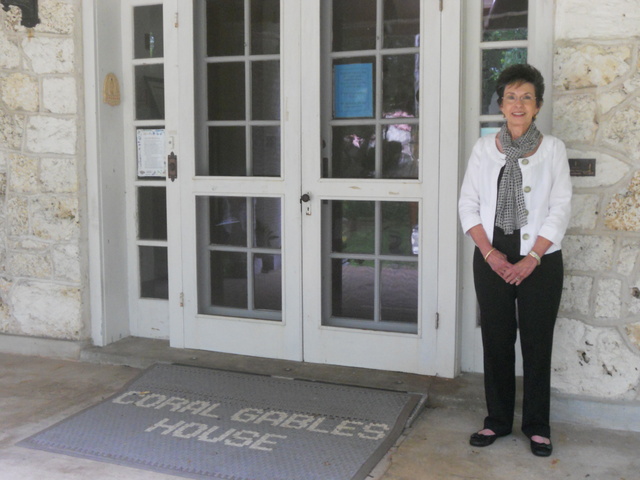
They set out on foot to explore our new neighborhood. Like Lewis and Clark they left with confidence. When they got home, I was told about a huge swimming pool called Venetian Pool in a place called Coral Gables. The next day, the boys and I walked to the pool. It had four cement platforms to jump or dive off. My mother gave us nine cents each to get into the pool.

I soon found out that I could earn money at Venetian. Tourist buses stopped at the pool. The tourists enjoyed throwing coins into the water and watching us dive for the money. They threw mostly pennies but sometimes a dime or nickel got tossed in. It was an underwater battle trying to be the one who got to the money first. I did well and almost always picked up enough money to buy a hot dog. Venetian Pool’s hot dogs were the best.

In the summer, we would walk to Venetian and swim all day. The pool had a natural cave with water in it. It also had an underwater hole in the wall that kids could swim through. We kids would wait in line to have a turn at diving underwater and swimming through the hole. I was always afraid that someone would grab my foot and stop me from going through the hole and then I would drown. Glad to say it never happened.

But the best-ever Miami story for me was on January 5, 1985, when I ran 26.2 miles from Baker’s Haulover in North Miami Beach to Miami, and then to Coconut Grove. I’ve never felt so proud of my hometown and the people than when I ran in the Orange Bowl Marathon. All the people along the race route helped and encouraged me to keep on running. There was the enthusiasm of two ladies on Miami Beach who clapped in time to their cheer, “Go runner, go!”

It put a smile on my face and gave me new energy to keep going. I passed an elderly couple who had set up an “aid station” and obviously spent their own money to buy paper cups and water for the runners. There was also a young girl sitting on a sidewalk who was cutting orange slices for her friend to hand out to the runners. These people and many more caused me to be so proud of Miami, my city. When I think of all their kindnesses, I get tears in my eyes.

A vacation from my very first job in New York brought me to Miami Beach in 1952 where I stayed with a family friend, just blocks from the ocean.

“Aunt” Gertrude Reid, aka “Madame Zaza,” was a crystal-ball gazer who worked at the Kenilworth Hotel, where Arthur Godfrey did his broadcast. The apartment where I stayed was on 41st Street, down the street from the first Lum’s Restaurant.

The jitney ride from the railroad station to Miami Beach was exciting for a girl just off the train from New York. Miami is where I have stayed and raised a family, and they raised theirs here, too.

My decision not to return to New York caused my parents and grandfather to move here. I worked as a medical assistant for Dr. Koenigsberg in North Miami, and then for the Miami Fashion Council in the Chamber of Commerce building downtown.

I met and married my husband here that year, and we lived on a block off Miami Avenue on Northwest 55th Street in a furnished apartment with caring landlords, the Hollandys. The area was beautiful – a white duplex with palm trees painted on the front wall. There was a concrete table with umbrella on the grass next to the building and it was surrounded by beautiful hibiscus. My grandfather loved to sit there when he visited. He continually marveled at being in Miami.

My parents had a place near the bay on 26th Street. Mom and I wore hats and gloves when we went to Flagler Street, to Burdines Tea Room, or when we shopped at Oelkers for material to make hats and ate at the Town Restaurant.

Mal Marshall had a clothing factory on Miami Avenue (and occasionally allowed the public to make purchases) and we were introduced to the “Cubavera” style, fashion with a Latin flavor. Rome Mattress Company provided bedding for the area and Sterling Equipment outfitted restaurants.

Smitty’s Barbeque on 36th Street served pretty good food, and Edith and Fritz on Miami Avenue offered all-you-can-eat items for $2. Seven Seas couldn’t be beat for seafood. B-Thrifty was the grocery store of choice close by. In Hialeah, where my husband worked, there was another favorite place to eat, Steven’s (aka Whoppie’s).

Miami Beach offered treats like seeing Sammy Davis, Jr. as a very young man, dancing with the Will Mastin Trio at the Rockin’ MB Lounge right next to the beach, across the street from the Roney Plaza Hotel, and the Noshery, also on Miami Beach.

A move out west to Schenley Park brought us closer to Variety Children’s Hospital, ice cream at Milam’s Dairy and pony rides at Suniland Park. Hardware items were purchased at Salem Supplies on Douglas Road, and Mainly Art was the place for framing and supplies. The South Dade Jewish Center was born in the living room of Elsie and Joe Segal in 1955, later to become Temple Beth Am when the building went up in 1957.

A move farther west saw three children at Blue Lakes Elementary, Glades Middle School and Killian High School. We roamed horse farms, strawberry and tomato fields, the roads west to Krome Avenue, and south to Knaus Berry Farm. There was no charge to enter Matheson Hammock. There was easy, free access to the sea wall down at the Deering Estate off Old Cutler where snapper could be caught with little difficulty.

Shrimp cocktails on Key Biscayne at the Hurricane Harbor Lounge were $1.50, and Leonard’s La Pena on Bird Road served ONLY shrimp cocktail and steak. Whitey graciously showed you to your table at The Pub on Coral Way, where the lettuce wedge was huge. Sam & Carl’s Deli on Red Road was a favorite, too, serving a “Messy Bessy Sandwich.”

A trip into Coral Gables netted you delicious pastry at Andalusia Bakery, and there was Woolworths, and Jan’s for outrageous ice cream concoctions. Jimmy’s Hurricane on Bird Road, Chesapeake Oyster House in the Gables, and Perrine were popular restaurants.

My father worked at Steven’s Market on Red Road, and played cards with Abe Katzen, who owned the 5 & 10 Cent store on Red Road in South Miami. My mom worked at Stanleighs and at Claire Whyte, both on Miracle Mile. At one time, my parents owned Toni Lords, a gift shop on Southwest Eighth Street across from the Garden Restaurant.

My mother was a veteran volunteer. She and friends started the Park West Cancer Support group with help from David Blumberg. My mother was a “listener” at school, and on the phone with children who returned to empty homes after school, as their parents were still at work. My daughter worked at J Byron’s on Miracle Mile and then for Bernie Janis, who was a pioneer in West Kendall.

My sons worked at Nathan’s, KFC, and Kmart while in high school. They continued their education, married, and raised four children in Miami, with one set defecting to Coral Springs.

My husband was a successful businessman who loved music and art, fishing, and handball at Flamingo Park on Miami Beach. He and his partner in handball and business, Eugene Fleischer, built the José Martí building on Southwest Eighth Street, still there, with a ceramic map of Cuba on the west wall created by Fran William, a local artist of the day. They also built Westchester General Hospital for Dr. Maury Fox, and a division of the first Century Village in West Palm Beach.

My husband was active in Toastmasters, and together we were active in the Miami Power Squadron, and as docents at Metro Zoo for many years. We enjoyed opera at the Dade County Auditorium, and pizza at Santacroce near the University of Miami.

The third generation is on the rise in a wonderfully burgeoning Miami with its downtown/midtown revival and unique multi-cultural flavors.

As I stroll through Biscayne Boulevard I glance up to see La Torre de la Libertad, a former political asylum center for Cubans. Although the Freedom Tower no longer carries out its administrative function, it continues to serve as a beacon of welcome for all Cuban refugees, those of the past and future.

The tower elicits few emotions inside of me, since I arrived from Cuba at the age of 3; however, it does remind me of both the triumphs and struggles my parents endured when settling in Miami in hopes of creating a brighter future for me, their only daughter.

My parents were among the influx of immigrants who arrived in the late 1990s. My father, Roberto Perez, arrived on a Friday in 1999. The following Monday, he began working as an electrician by day and cleaned restaurants as a busboy by night.

Six months later, my father found himself waiting in the airport with a bouquet of roses and a balloon that said, “It’s a Girl” (he still had not enrolled in English classes). Before he knew it, he was reunited with his young daughter, wife and mother-in-law. With a family under his wing, it was time to move forward at full speed; fortunately, my mother and grandmother were by his side.

Only a month after my mother Ani arrived, she eagerly began learning English at the Adult Education Center at Coral Gables Senior High School. She later enrolled in the REVEST program, an English class tailored to immigrants, at Miami Dade College Wolfson Campus.

While taking classes, she worked in the jewelry department of Service Merchandise. It was her first job in America, one she remembers clearly from soaking her feet in a bucket of hot water each time she came home from work.

The following year, she enrolled in MDC to take computing and accounting classes as well as ENC 1101. At the age of 30, she sat alongside recent high school graduates. While taking ENC 1101 in the day, she took on a night job as chief of data input in the Miami Jackson Adult Education Center.

My father also completed the REVEST program at night, while continuing to work as an electrician in the day. He continuously hopped from company to company in search of a higher wage.

Fortunately, my grandmother offered to stay home and take care of me so that my parents could work and further their education at the same time. My household valued what it meant to be a family. Even as a child, I realized the continuous interplay of teamwork among us. They figured that if they overcame the hardships of Cuba together, then they would surely overcome these times as well.

Once I was old enough to go to school, my grandmother Miriam Alderete was hired as a Spanish teacher at a private K-8 school, where she worked for 14 years. She was recognized by the Institute of Hispanic Culture with the Academic Order of Don Quijote de la Mancha award for her excellence in teaching Cuban literature.

The pivotal point in my father’s career occurred when he matriculated in vocational classes in electricity at Miami Senior High to obtain his journeyman license, which soon proved advantageous when he was hired four years later as an electrician for Miami-Dade Housing, and later as a plant electrician for Miami-Dade Water and Sewer.

No longer being able to bear going to work when I came home from school, my mother took her Florida teacher certification examination and was hired as a full-time teacher at Booker T. Washington Senior High. She woke up at 5:00 each morning for five years to avoid the expressway traffic heading to downtown; still, she thought it was worth it.

In 2004, my brother was born and so my mother transferred to Miami Sunset to be closer to home. She earned her master’s in mathematics education from Nova Southeastern University five years later. Soon after, it was my father’s turn as he earned his master’s in electrical, burglar alarm and fire alarm specialty.

While growing up, I saw my parents build a new home, a new life and even extend the family, whether it was by having another child or lending a hand to others so they too could build their new lives.

As refugees we cannot measure how grateful we all are to have been able to step foot in Miami and watch our lives unfold in ways we could have never imagined. However I am even luckier than my parents because I have been able to “stand on the shoulders of giants,” as Isaac Newton said.

My parents, along with other refugees, have played their own role in the building of the city, but most importantly they have laid the foundation for the next generation. They held our hands and carried us on their backs through the storms of adversity the new country brought forth only to steer us into calm waters, hand over the wheel and say, “now it is your turn.”

They call Miami “the Magic City,” which is fitting, because it’s always able to reinvent itself.
I was born in Hialeah Hospital in 1981. History is full of eras, but this specific moment was the beginning of change, an almost traceable line of demarcation.

My mother fled Cuba in 1969 when she was 19 with her sister and my grandmother; my grandfather, a political prisoner, joined them five years later. She met my father after he arrived here in 1979, after 20 years as a political prisoner in Cuba.

I belonged to two worlds. I was an American, but at the same time, I was Cuban. I didn’t quite fit either group. In many ways, my story is the story of the city in which I was born: Hialeah is part of South Florida; yet, it feels totally different from Tallahassee, or Tampa, or Titusville, and worlds away from “the South.”

Hialeah, like South Florida, isn’t just one place, it is many simultaneously. As such, every major street carries at least three names. Red Road is Northwest 57th Avenue, West Fourth Avenue, or la cuatro.

In 1981, South Florida was just barely recovering from a riot and an influx of Cubans that arrived on the Mariel boatlift – events that shaped public discourse, policy, and dinner table conversation for years.

My parents’ first home was in a community called Lago Grande. It was so new that there was nothing nearby and it seemed like it was in the middle of a forest.

My grandparents lived in East Hialeah, back when there were no Spanish-speaking neighbors. To visit, we passed the Holsum Bread factory and the smell of bread filled the car. We passed Hialeah Racetrack, filled with photographers taking their iconic pictures of Quinceñeras in their poofy white gowns, among the pink flamingos and peacocks. There was a viandero who drove by and sold yucca and chorizo, as well as an ice cream truck whose Pink Panther ice cream bars with gumball eyes always tasted better than those at the store.

Vendors walked up and down 49th Street selling fresh churros – coated in fine granulated sugar that always managed to make a mess, making them contraband inside my father’s car – and little white paper cones of roasted peanuts.

There was a Jumbo Supermarket, where Cuban bread disappeared as soon as it was out of the oven, a Latin American restaurant – where I first saw ham hanging from the ceiling – and a new McDonald’s where I met Ronald McDonald and had my face painted.

Ocean Drive wasn’t as popular as it is today, but the beach was always full of visitors. I bounced over waves – wearing pink floaties and building sand castles on beaches – wearing Coppertone sunblock, because that’s what the little girl on the billboard used. We parked at Penrod’s, today’s Nikki Beach. And one of the major rites of passage into teenhood was taking a leap off the South Beach pier.

Everyone loved the Dolphins, Don Shula and Dan Marino. Everyone remembered their perfect season. All this started to change in the 1990s.

When I was 5, we moved, and our family now included my new little brother. I enrolled in a new school, Ben Sheppard Elementary. In third grade, the family moved to Miami Lakes. This was the edge, the newest part of town – again, right next to the “forest.” Everything south of Northwest 149th Street was filled with dense trees. As kids, we rode our bikes into “the forest” and half believed we’d find monsters, wild animals, and maybe even Tarzan. Those were the trees eventually plowed down for new homes and for Barbara Goleman Senior High.

In the 1990s, Art Deco became cool and South Beach was the place to see and be seen. The University of Miami Hurricanes became champions in football for the fourth time, we got a basketball team, and there was a struggle to protect decency: Sheriff Navarro banned a 2 Live Crew record, and Palm Beach banned female street hot dog vendors wearing thong bikinis.

Like today, there were plenty of political scandals; somehow, hundreds of dead people voted in a mayoral race. There was a flood of immigrants – thousands of Cubans braved the sea on rafts, tires, and just about anything that would float, prompting President Clinton to enact the Wet Foot / Dry Foot policy.

Hurricane Andrew arrived on what was supposed to be my first day at Miami Lakes Middle School. Other than downed trees, we were fine. But other parts of South Florida weren’t as lucky. School was delayed almost two weeks and many kids were displaced, left homeless by the storm.

Eventually there was a building boom and Miami’s skyline changed. . At that time, my mother was a vice president at Capital Bank and excited to move into a modern building in the “new” downtown, and even more so when it appeared in the movie “Bad Boys.” But after 5 p.m., downtown died. Stores and businesses closed for the night.

I attended Hialeah-Miami Lakes Senior High before the FCAT, when kids carried beepers, not cellphones. Football was big. Everyone attended the game versus Hialeah High, our biggest rival. The coveted T Trophy always resided at HML.

After graduation, I attended UM and completed a double major in journalism and English. My husband and I, high school sweethearts, married and moved to Miami Lakes. I teach at Miami Lakes Educational Center and he is a CPA with a small firm in Hialeah.

We stayed close to home. But home keeps changing. The Miami of my childhood doesn’t exist anymore, but neither does the Miami of 10 or even 5 years ago.

But some things remain unchanged. You can find anything that you need in Hialeah and all the streets there still have three names, although la doce, Ludlam Road, 67th Avenue is now also Flamingo Road, but that’s a whole other story.

I reached to pull the yellow lever that would release our glider’s tether to the noisy silver crop duster that was towing us to 3,000 feet over Homestead at the edge of Florida’s Everglades.

This lever — and the towrope that connected us to the plane — was our only link to the powered flight. If I tugged the lever toward me, we’d be on our own in the ether, no engine, just a narrow white cylinder with wings relying on elusive warm updrafts to keep us aloft. My new boyfriend, sitting behind me and piloting the glider we had rented for an hour, had instructed me to release us from the crop duster — but I hesitated.

The origins of my fear of flying are a mystery to me.

I’d suffered life-long psychological paralysis surrounding air travel. Maybe this fear was the result of an association between flying and becoming motion sick at 7 years old as an unaccompanied minor on a flight from Miami to New York. Perhaps the dread was the due to being tossed around in a seaplane in a terrifying lightening-rife storm halfway to the Bahamas from Miami. Maybe a clue to my irrational fear could be found in the panic attack and vomiting episode just after take-off from Miami International Airport after drinking too many dirty vodka martinis in the airport bar in an effort to quell my terror of jetting to Philadelphia.

I didn’t fly anymore. Period.

Over the years, I’d ridden almost every rail Amtrak travels. I’d taken the Queen Mary 2 to Europe and back over the North Atlantic, avoiding air travel and eating a lot of shipboard scones. I turned down free vacations to places in corners of the globe where it would have been impossible to travel expediently by land or sea. Amtrak doesn’t go to Malta.

The irony of my fear is that I’m an exotic-bird enthusiast, expert, and rescuer. I’ve written more than 30 books and hundreds of magazine articles on the care and training of parrots, canaries, finches, and doves. I’ve been a fan of birds since I was a little girl when my grandfather taught me how to charm pigeons to eat from my hands in the coop he built in the backyard of our South Miami home. Birds are the only animals with feathers, structures so strong they can lift a wearer many times her weight into the air for flight across oceans.

But I wasn’t a bird.

I found comfort in the terra firma. So how was I gliding over palm tree nurseries and sawgrass prairies at the edge of the swampy Miami wilderness in an engineless aircraft, being asked to pull a lever that would set the glider free? I hovered my hand over the T-shaped bar with its chipped canary-colored paint and thought about the risks of becoming unanchored and set adrift. What if the sky couldn’t sustain us? We were, after all, heavier than air, and unable to flap like birds.

My paramour is an officer in the Coast Guard based at the Opa-locka air station whose job is to fly helicopters over the South Florida seascape to spot Cuban migrants, save people from sinking boats, and pluck heart-attack victims and pregnant ladies in labor from the decks of cruise ships. He earned a medal for rescuing people from rooftops after Hurricane Katrina, an honor for which he is too humble. He teaches people to fly small planes and gliders and has a 4-seater plane of his own. There could be no one better with whom to share the sky.

I wanted to pull the yellow lever. I have a vague understanding of how wings work, but for the most part, keeping a 10,000-pound hunk of metal airborne seems like magic to me. What if I pulled the lever and we plummeted like a pelican into the sea?

The yellow lever was warm as I grasped it and eased it toward me. With a clunk the glider lost purchase on the towline and we separated from the noisy tow plane, leaving us alone with the only sound of the air whooshing over the clear plastic hood above our heads. Below us, houses with blue backyard pools gave way to tomato fields, which yielded to vast swaths of wetlands.

No hyperventilating into the vomit bag he had brought for me. No crying or hiding my face in sweaty palms. No whispered foxhole prayers that if I made it back to the ground alive I’d never eat bacon again.

“Let’s fly with the birds,” my boyfriend said, turning the glider sharply toward the hazy blue Atlantic.

He knew my weakness. He had told me that a great way to find updrafts—the fuel a glider uses to stay airborne — was to follow turkey buzzards as they swirled beneath the clouds, rotating inside an invisible funnel of wind. We flew toward three buzzards, their black wings outstretched, feathers gleaming in the sun. I forgot about being half a mile above the earth, instead focused on how close the birds allowed us to them, the communion we shared up there in the firmament. I forgot about gravity. I forgot that I was afraid.

Maybe my fear of flying isn’t about plunging to the ground at maximum velocity in an exploding tube filled with fire, as I had once believed. Maybe I just hadn’t met anyone until that moment that made flying fun, someone with whom I wouldn’t mind being set adrift. Experiencing flight with him had become, in a single gesture, with the pull of a yellow lever, more important than my anxiety.

My dad, Anthony Abraham, just turned 99 and lives in the same Coral Gables house he bought in 1952.

I wasn’t even born yet, but my mom, dad and my three siblings — George (7), Marion (5) and Judy (3) left Chicago and arrived in Miami in 1950 along with my cousin Dorothy, who was 16 and planning to attend the University of Miami.

Rumor was that my oldest brother George had asthma and it was advised that he should live in a tropical climate. My dad wasn’t going to move to the Caribbean, so Miami was the best solution.

When my family first arrived, they stayed at The Casablanca Hotel on Collins Avenue in Miami Beach. Driving up to the hotel, there was an Arabian Nights-themed porte cochere featuring four giant genies (originally nude but eventually draped due to controversy).

The fun times for the kids was going to the movies at the Miracle Theatre on Miracle Mile in Coral Gables or swimming at the beach in Crandon Park.

Later, my family rented a house across from the hotel for one season. They used to go to Wolfie’s, the landmark restaurant at 21st Street and Collins Avenue. It was the family hangout; the place was always crowded and opened 24 hours. Sadly, the restaurant closed in 2002.

Meanwhile, while house-hunting in 1952, my mom found a house in Coral Gables, perfect for the whole family. There was a fireplace in the middle of the living room, which is no longer there, nor the terrazzo floors.

My mom loved to cook Lebanese food and have the family over for Sunday dinners. I loved to help my aunts in the kitchen rolling up grape leaves. It would take two days to prepare our feasts — kibbee, tabouli, grape leaves and cabbage leaves stuffed with Lebanese style rice and lamb.

On Aug. 24, 1956, a wonderful life began for my brother Tommy, who was 4, and me, age 5.

My mother and dad came to Beirut, Lebanon, to visit our orphanage, The Creche. They came to visit the children and brought toys. Tommy, who went by the name Ghattas, elbowed my dad while I tugged on my mom’s skirt. Without any hesitation or spoken words, they adopted both of us.

My other siblings were all adopted at birth. George came from Kansas City, Mo., Marion was from New York City, and Judy was from St. Louis, Minn.

When we arrived in the summer of 1956 on National Airlines, we were greeted by Ralph Renick, the legendary Channel 4 anchorman. We could only speak French or Arabic, except the words, ‘Thank you,’ which my dad had taught us on the plane. When we arrived at our new home, we saw the pool and our reflection in the pool. This was the happiest moment of our lives.

My dad owned what became the largest Chevrolet dealership in South Florida on the corner of LeJeune Road and Southwest Eighth Street.

Eventually, he bought the land across the street for used cars, then haggled with the fruit market owner to buy another piece of land on the other side for the truck department. At one point, he owned every corner of LeJeune and Eighth Street.

My parents had become part of the social circle in the ’60s and ’70s. They were a part of a new organization, ALSAC (American Syrian Lebanese Associated Charities), which still exists today. The entertainer Danny Thomas, also of Lebanese descent, founded St. Jude’s Children’s Research Hospital with a group of Lebanese businessmen, including my father. They created a board in 1957. Today, second and third generations of the original families, including my brother, Tommy, sit on the board.

In the late 1950s, my parents started a local fundraising event for the hospital, called The Miracle Ball. Danny Thomas would bring a different celebrity to the event each year. Robert Goulet, Perry Como, Sammy Davis Jr., and even Frank Sinatra performed at the last ball in 1984, which was dedicated to my mom.

We used to host the pre-cocktail party at our home, but eventually started having the party at the Eden Roc hotel. The gala was held at the Fontainebleau hotel, when Ben Novack owned it.

Mr. Novack had bought our house while we were in college, but when my brother and I returned to Miami, my brother insisted my parents buy it back, which they did in the 1970s.

My brother and I went away to college but returned to Miami. I have followed in my mother’s footsteps, fundraising and hosting parties in my home. My brother Tommy has taken over the family foundation and runs our dad’s office. My father eventually sold the dealership, then repurchased it in the early ’80s.

He sold in again in the late ’80s. My dad finally retired after my mom was taken away from us in 1984. He has dedicated the rest of his life to helping schools, hospitals and churches.

I have been so blessed to have been chosen by two remarkable, loving and generous parents. My father’s motto for our family foundation is: “Always help those less fortunate, no matter what race, color or creed they were.”

My father was a fisherman, as were his fathers, and since I followed in their footsteps, I am a fisherman, too.

He fished the streams of Scotland as a boy and, when he came over to Orlando, he fished the freshwater lakes and Indian River, catching bass, trout and flounder. Later, one of his outstanding Metropolitan Tournament winning catches was a 25-pound redfish he caught while fishing with his brother-in-law, Carl Lauer, at Flamingo in 1962.

In 1963, my father retired from Southern Bell and went to Freeport, Grand Bahama, to manage the telephone company for a few years. Then he consulted for a few independent telephone companies around Florida until he died in 1970 at 67 years old.

My family and I first moved to South Florida in 1945. As a kid, I remember winning some fishing contests, then identifying fish on an outdoor radio show in Jacksonville. I fished the Palm Beach Inlet Dock with my father and, in the evening, jacks and snook would chase schools of mullet onto the beach and the rocks. A large moray eel lived in a pipe by the dock, and there was only one building to be seen across the water on Riviera Beach (a nightclub?).

I came back in the 1960s to fish the mullet run each fall, becoming the only Miami member of the Jetty Conchs fishing club.

In 1946, we moved to Coconut Grove and kept our boat in a canal near the end of Southwest 22nd Avenue. This area east of Bayshore Drive was all mangroves at that time. I remember fishing off Key Biscayne before they built the bridge, and in the bay, we caught snapper, trout and mackerel using small surf rods with 36-pound squidding line. Boats would come into Dinner Key, and then people would load their car trunks full of fish.

After we moved back to Jacksonville in 1948, we often fished the bridges around St. Augustine, Matanzas Inlet and the old Mandarin loading-dock piling south of Julington Creek on the St. Johns River.

In 1954, my parents moved back to the same neighborhood in Coconut Grove and bought the house where my family and I live now. At this time, my father and I became interested in spin fishing. Our first reels were Garcia Mitchells, then Orvis 100s.

In 1955, I started working summers at The Tackle Box fishing store at Southwest 27th Avenue and U.S.?1, where I built custom fishing rods and repaired reels for the proprietor, Jack Primack. While working there, I met many people who were influential in my early development as a light-tackle sport fisherman. Some of the names I remember are: Eddie Miller, Joe Brooks, Lee Cuddy, Arthur Beryl, Buddy Hawkins, Capt. Bill Smith, Capt. Stu Apt, Capt. Gary Simmons, Capt. Bill Curtis, Chico Fernandez, Flip Pallot and John Emery.

In 1958, I went away to the Army and upon my return in 1961, I started surveying for the new Dade County Port of Miami. I also built custom bonefishing skiffs at the Glenncraft boat company. Eventually, I built my own skiff and went fishing most of the time. During this period, I developed innovations to the technology of sport fishing, some of which are still being used in the fishing community today.

Among the innovations I primarily created are: Inside/Outside Fly, Mutton/Cockroach Fly, Puff Permit Fly, Twenty-Times-Around Knot, wire-leader connection, Duncan Loop Knot, deep jig glow worms, boat side curtains and rod blank designs. Other innovations that I contributed to were: arrowhead jigs, inverted flies, loop-on fly tippits, Redfish Fly, sinking head fly lines, blue fly lines, red bandannas and the first fiberglass push pole.

I returned to college part-time, eventually obtaining an engineering degree from the University of Miami and several professional licenses. I have recently retired with 30 years of experience as a construction management engineer. I also became involved in several conservation issues, such as the creation of Biscayne National Park and the banning of commercial fishing in Everglades National Park.

Many things have changed now, but partially because Biscayne National Park was created at our doorstep, we still have fish in Biscayne Bay. On a recent trip, I caught a nice mutton snapper in park waters. I used the head and bones to make fish soup and the sauce for my quenelles.

I still look forward to fishing, although it is now a new era and there are fewer fish than there were back in the ‘50s and ‘60s. However, we can turn the tide if sport fishermen keep pushing for reforms in the preservation and conservation of our natural resources.

It was the summer of 2003; I was living in a very old and ugly apartment building between Biscayne Boulevard and Northeast 2nd Avenue, off of 33rd Street.

I had a bitter, mentally unstable landlord that walked around with a concealed weapon. I had a part-time gig at the Historical Museum of Southern Florida, now Museum of Miami. I would give guided tours of the permanent galleries and write historical theater scripts for their summer camp program.

Every afternoon of that summer I would arrive home from work, and I remember noticing really shady people coming in and out of my building — pimps and prostitutes — the same ones I would see walking the sidewalks while driving on the Boulevard. I also remember a particular barbecue smell circulating the hallways of the building.

This one time I was sitting in my writing chair, trying to figure out an ending to three of my stories when suddenly, the phone rang. I answered it.

“Hello?”
“Oscar?”
“Maybe…”
“Hey, this is your landlord.”
“What do you want?”
“What do I want? I want my rent, you punk!”

I hung up. Couldn’t really stand people cursing on the phone. Especially annoying landlords like mine. This was the worst landlord I ever had. Two days late from the first of the month, and he was already calling the cops on me.
There was a knock on the door. I picked up a bad reading on it, but answered it anyway. It was my neighbor, the stripper. She was 75 years old. She had a six-pack of beer, Heineken. I let her in.

She always wore a mini skirt, and the skin on her legs was all loose and hanging down. Her teeth were yellow and twisted. She always bragged about how in her younger years, she was the hottest stripper in Miami, but now she was old, sick, and very tired.

We drank the beer and talked about the poetry of life. I mentioned the aroma in the building, and how it always smelled like barbecue. She looked at me with frozen eyes, slowly pointed at my back window and said, “Oscar, there’s a smoky chimney out there…” I got up to see and there it was, a smoky chimney right outside my window. I didn’t ask her anything about it; I figured I would go down there and see for myself. After a while, she left. I kept on writing. The phone rang.
“Yeah?”
“Goddamn it, Oscar, I swear you hang up on me one more time, I’ll put a bomb on your door knob.” It was my landlord again.

“What do you want? You want my rent?”

“My rent! I want MY rent!!”

“Come pick it up.”

“At what time?”

“Come now, you lizard.”

“Oscar, if I go there and I don’t find you, I swear to God I…”

I hung up on him again. Couldn’t really stand people bitching on the phone. Someone knocked on my door. Someone knocked three times. I opened it. It was a giant lizard wearing funky sunglasses, shorts, sandals, and a funny haircut. It also looked like an iguana, but it was my landlord.

“What are you doing here?”

“Oscar, I had it up to here with you.” He told me, pointing at his stomach.

He was a very tall man. Always smoking a cigar. Heavy set, about 300 pounds. With a heavy breath. Minty breath. Tobacco minty breath. He looked insane and dangerous.

“Your rent is two days late, Oscar!” He screamed, taking out his .45 caliber. He pointed the gun at my left knee. I froze. I didn’t want to move. He walked around me, and now he was inside my apartment, pointing that thing at my back.

“I want my money, Oscar. Where is my money?”

“Look Pops, just take it easy.”

“I’ve been taking it easy for the longest.”

“Look man, I don’t have your money here in the apartment.”

“What?”

“We gotta take a drive to the bank on Coral Way, and my car’s out of gas.”

“That’s no problem, we’ll go in mine.”

We left the apartment. He drove his car and steered the wheel with his left hand, while he pointed the .45 at my stomach with his right.

We arrived at the bank. It was closed. Most banks closed around 5:00 in the afternoon; it was 4:45 p.m. The lizard made me knock on the front glass door of the bank. The employees that saw me knocking didn’t even look twice. They all just stood there counting their money. Thank God it was closed. My bank account was empty. Suddenly my chance to kick the gun out of his hand came my way. His eyes opened wide; he couldn’t believe I had just kicked that thing out of his hand. I couldn’t believe it either. I picked it up fast, and aimed it. I could smell it running down his pants.

“This is where you lose, lizard.”

“You got a bomb on your door knob, Oscar.”

“That’s why you’re going to open it for me.”

“In your wildest dreams!” He screamed, as he ran away from me with surprising speed.

I walked over to the lizard’s car. He had left the keys in it. Got in. turned it on, and drove off into the congested streets.

Back at the apartment building, I stood outside wondering about that smoky chimney. I walked around the block on Northeast 2nd Avenue to see what building was the one with the chimney. I looked and it read, “Van Orsdel Crematorium.” I stood there feeling shocked. It all made morbid sense. The dust on my window sill was no dust and the barbecue smell that circulated the hallways was no barbecue.

I was born in Brooklyn, New York, in 1947. My parents were also born in Brooklyn, and their parents emigrated from Russia to the United States between 1910 and 1912, arrived at Ellis Island, and settled in New York.

I have great memories of growing up in Brooklyn and remaining in Brooklyn as an adult. I taught English at Meyer Levin Junior High School from 1970 until I retired in June 2001. After retirement I moved to Rio de Janeiro, Brazil, and lived there for five years. It was a wonderful experience!

Upon returning to New York in 2006 I found dealing with the cold winters more and more difficult. Finally, in August of 2010 I made the move to Miami, and I am happy to say that I am now a permanent resident of “The Magic City.”

Actually, my connection to Miami goes back to 1955 when my father’s parents became “snowbirds” and began wintering in Miami.

They bought a home at 1325 SW 40th Avenue in Coral Gables, and my parents, sister, and I drove down every year during Christmas vacation as a family until 1964. I continued to come down during my college breaks until 1970. Between 1955 and 1962 we stayed with my grandparents in Coral Gables. My grandfather then sold his house and leased a hotel on Miami Beach – The Premier Hotel on Collins Avenue and 8th Street.

Of course, then it was called Miami Beach; now it’s called South Beach, and the hotel has become a Victoria’s Secret store. For our visits during 1963 and 1964, my parents opted for more comfortable accommodations.

In 1963, we stayed at The Cadillac Hotel on Collins Avenue and 40th Street, and in 1964, my last trip with my parents, we stayed at the Chateau Resort Motel in Sunny Isles. I continued coming down until my grandfather retired from the hotel business in 1970, and that was the end of my Miami connection for twenty years.

I do have some very fond memories of my childhood and adolescent visits to Miami and Miami Beach, and here they are:

– Going to the beach and zoo at Crandon Park. I remember the peacocks walking around freely and the miniature train ride around the zoo.
– Swimming in the Venetian Pool.
– Stopping at Burger King, the first Burger King I had ever been to (there were no Burger Kings in New York at the time), for a Whopper and a chocolate shake.
– Going to Tyler’s Restaurant on Ponce De Leon Boulevard. I especially remember the chocolate and banana cream pies.
– Going to the movies at the Coral Theater on Ponce De Leon Boulevard and the Miracle Theater on Miracle Mile. I remember seeing “Auntie Mame” at the Miracle.
– Going to Pizza Palace and Krispy Creme on SW 8th Street. It wasn’t called Calle Ocho then.
– Buying fruit at the fruit market on the corner of Le Jeune Road and SW 8th Street I can still smell the wonderful aroma of the oranges.
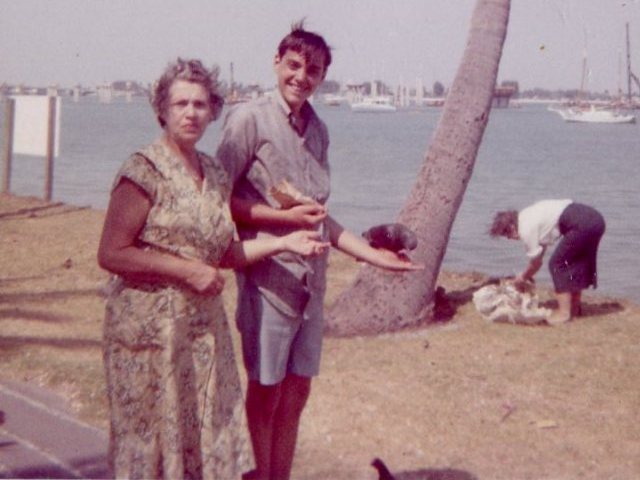
– Feeding the pigeons in Bayfront Park and going to Pier Five in downtown Miami.
– Passing Burdines and seeing the amusement park on the roof and the big neon Santa between the buildings.
– Going to the original Parrot Jungle and Monkey Jungle and taking an airboat ride in the Everglades.
– Going to FunLand Amusement Park on NW 27th Avenue and 79th Street.
– On Miami Beach, eating at Pickin’ Chicken, Picciolo’s Italian Restaurant, Wolfie’s, on 21st Street and on Lincoln Road, The Noshery at the Saxony Hotel, Famous Restaurant on Washington Avenue, and Hoffman’s Cafeteria on Collins.
– Going to the movies at The Caribe Theater on Lincoln Road. I saw “The Planet of the Apes” there in 1968.

My parents retired in 1977 and moved to Florida. They bought a condo at Kings Point in Delray Beach. I would come down to visit them during my Easter breaks, but this place was not my cup of tea. Then in 1990, I took a ride down from Delray to Miami Beach with my parents, and the magic hit me again.

At that time, South Beach, as it is now called, was going through a renaissance, and I was hooked. It was at that point that I started to think that this is the place where I would like to retire.

Now, here I am back in Miami, sadly, many of the places I remember from my childhood and adolescent visits no longer exist. But Miami has moved forward and is now a world-class city, and I am happy to be a permanent resident of this “Magic City.”

Translate »